published on: 07.09.2026
last updated on: 08.09.2026
Nowadays, creating a podcast means more than just hitting the “record” button. It’s how you record a podcast, write a podcast script, engineer episodes, and stage your podcast segment ideas-from a microphone choice to the setup in your studio-that really matters.
The following are the best podcast microphones, organized by budget tier: Under $100, $100-$200, and over $200. Specific models, pros/cons, approximate prices in USD, specifications, use-cases, and what to consider when buying are also included.
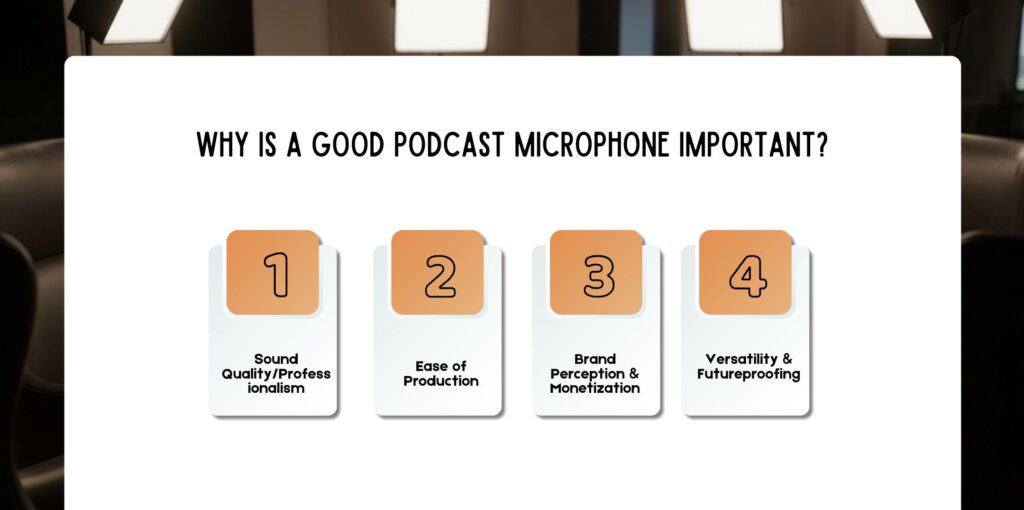
Why Is A Good Podcast Microphone Important?
A great mic will capture your voice clearly, reject background noise, and position your show in a professional light. Choose poorly, and you’ll spend more time editing or lose listeners needlessly.
Sound Quality/Professionalism: This clarity of sound would make more sense to the listener of the podcast while being engaging and building credibility.
Ease of Production: A good microphone minimizes the background noise, echo, and plosives. That means less time editing, more focus on actual content: the structure of the episode, script, and segment ideas.
Brand Perception & Monetization: If you want to monetize, sponsor, or partner, your audio quality represents your brand. Mediocre-sounding mics are not going to do much in bolstering this end.
Versatility & Futureproofing: A good choice of microphone in terms of connectivity and features allows for upgrades from solo to multi-format hosting, interviews, guests remotely, etc.
Best Podcast Microphones (Budget Level: Under $100)
These are ideal for beginners, super-low-budget studios, and podcasters wanting to have a plug-and-play microphone without investing too much. While they don’t have some of the features of higher-end gear, they are a very good value.
1. FIFINE Dynamic Microphone (US $60)
Very low cost, usually connected via USB.
Use case: Entry-level podcasting, solo host, minimal editing
Pros: cheap, decent sound for its value.
Cons: Basic build and may pick up room noise if untreated, fewer features; the XLR is often not included.
Cons: Lower audio quality compared with more expensive microphones; USB only; may require a quiet space
3. Samson Q2U (US $69)
Dynamic USB/XLR hybrid mic.
Specifications: Dynamic element, cardioid pattern. Frequency response – 50Hz-15kHz.
Pros: USB & XLR means you can start off simple and upgrade to a mixer/interface later. Low noise pickup due to the cardioid dynamic element.
Cons: Entry-level, so still some ambient room sound if untreated; may require an interface if using XLR
Ideal for: Podcasters looking to have the flexibility to grow.
4. Audio-Technica ATR2100x (US $79)
A hybrid USB/XLR dynamic mic, known for strong performance in podcasting setups.
Pros: Excellent build, clean sound for its price.
Cons: The lower-end models are less developed than higher-end gear, both in tone and isolation, and in features.
5. MXL 990 (US$99)
Condenser mic with a vintage tone, XLR
Use case: studio or controlled room environment for narration, storytelling, or voice-over style podcasts.
Pros: Warm tone, large-diaphragm quality.
Cons: sensitive to background noise; not ideal in an untreated room.
6. Blue Snowball (US $69)
Condenser USB microphone
Pros: Easy plug-and-play; several models offer many pickup patterns.
Cons: Condenser nature makes it more sensitive to room noise; best in quiet, treated spaces.
7. Shure SM58 (US$99)
Dynamic XLR microphone, legendary in live sound, and robust build.
Pros: extra robust, crystal-clear vocals
Cons: Lacks some of the broadcasting features of newer, more podcast-specific mics; will need XLR interface.
8. Audio-Technica AT2020 (US $99)
Condenser XLR microphone
Pros: balanced, versatile; good for voice and ambient.
Cons: Again, a condenser means more sensitivity, so it’s less forgiving of ambient noise.
If you’re just starting with your podcast, find a mic that’s dynamic or cardioid to minimize the room noise; get one that is preferably USB if you don’t have an interface as of yet.
This way, you can make sure you are recording in as quiet of a space as possible. The above budget mics go well with most beginner setups.
Best Podcast Microphones (Mid-Range: US $100 – $200)
Those mics are much better in their build, in their sound quality, and features for podcasters who already have consistency-probably an audience just wants to have better production values.
1. Rode Wireless ME (US $149)
Instead of the usual mic, using a wireless lavalier is very suitable for mobile podcast or video use.
Pros: It includes mobility, flexibility, and good audio quality for interviews/moving hosts.
Cons: Slightly more involved to set up; wireless potential risks include interference.
2. Rode Podcaster (US $189)
Dynamic USB mic designed specifically for podcasting.
Pros: In-built pop filter, good sound quality, USB ease.
Cons: USB only – less upgrade path to XLR.
3. Blue Yeti (US $129)
Polar pattern, cardioid, bidirectional, omnidirectional USB condenser
Pros: flexible, great for a variety of podcast formats, solo, cohost, and interviews.
Cons: Condenser pickups ambient noise; you’ll want a treated environment or good mic technique.
4. AKG Lyra (US $149)
24-bit/192kHz high-resolution USB condenser with multi-mode settings.
Pros: Great recording, flexibility.
Cons: more wiring; probably needs a better environment.
5. Sennheiser Profile (US $149)
Dynamic USB-C mic for streaming and podcasting.
Pros: Gain/mute control built in, good for live and recorded scenarios.
Cons: Only USB, which is limiting if upgrading later.
6. PreSonus Revelator Dynamic (US $179)
USB-C dynamic mic with integrated DSP featuring voice effects and presets
Pros: Offers creative control.
Cons: More features might complicate your workflow if you just want to record something.
7. PreSonus PX-1 (US $129)
Condenser XLR microphone: Mid-range budget, probably a very good upgrade point into XLR territory.
Pros: Balanced reproduction of voice.
Cons: Requires an XLR interface; room treatment still counts.
8. Samson Q9U (US $149)
Dynamic hybrid USB/XLR mic
Pros: The flexibility to go USB now, XLR later
Cons: Mid-range, therefore still not fully high-end broadcast level.
9. Rode NT1-A (US $199)
Condenser XLR mic with ultra-low self-noise
Pros: very clear, professional-sounding tone.
Cons: XLR only; requires a good room and interface.
This is the tier where upgrades should be made when the producer is churning out multiple episodes, brings in guests, and wants better audio quality and flexibility.
More than just a microphone, this investment will include a good interface, acoustic treatment, a boom arm, a pop filter, and headphones.
This tier is for serious podcasters, production studios, and brands looking to have high-quality audio that differentiates them, and for whom budget is less of a constraint.
Here are some of the best podcast microphones that are over $200:
Cons: Needs substantial gain – good interface or “cloud-lifter”, more expensive, larger investment.
2. Shure SM7dB (US $499)
Like the SM7B, but with a built-in preamp/gain control, which reduces the need for external gain boosters.
Pros: More plug-and-play for podcasters who may not have high-end interfaces.
Cons: More expensive, plus it still requires a good setup.
3. Shure MV7+ (US $279)
Dynamic hybrid USB/XLR mic inspired by heritage from the SM7.
Pros: This includes features like USB for ease of getting started and XLR for upgrading, while including onboard DSP and a touch panel for control.
Cons: Not a full broadcast class like the SM7B, but very good value.
4. Shure MV7i (US $329)
Very similar to MV7+ but optimized for mobile / iOS workflow.
Pros: Very good for on-the-move content creators.
Cons: Less power than full studio gear.
5. Rode NT1 5th Gen (US$249)
Condenser XLR, ultra-low noise floor.
Pros: premium clarity, good for voiceover/storytelling.
Cons: require a quiet room and interface; generally, less background rejection than dynamic mics
6. Apogee HypeMic (US $349)
USB condenser with onboard analog compressor for a “broadcast” sound straight out of the box.
Pros: High-end features; great for solo or remote hosts wanting top quality.
Cons: USB only; premium price still.
7. Heil PR40 (US $349)
Dynamic XLR mic used in broadcast, podcast, and music.
Pros: Big, rich tone; captures voice beautifully.
Cons: Supports only XLR; expensive investment.
8. Electro-Voice RE20 (US $449)
Classic broadcast mic, used by radio and professional podcasters.
Pros: Legendary build and tone; strong off-axis rejection.
Cons: Bulky and heavy; higher cost and installation requirements.
9. Rode Wireless PRO (US $399)
Wireless mic system for mobile video/podcasting.
Pros: Highly flexible, great for out-of-studio interviews
Cons: Complexity of wireless workflow, including considerations for battery and interference.
10. Rode Interview PRO (US$299)
Handheld wireless mic system for interviews on the move or podcasting events.
Pros: Great for multi-location work.
Cons: Not as “studio” oriented as fixed boom mics
11. Lewitt RAY (US $399)
USB/XLR hybrid mic with adaptive voice processing & AI-assisted features.
Pros: Future-facing features, high clarity.
Cons: It’s pricey; too many features for a starter.
If your podcast is a business, you have guests, or you record in less-than-perfect rooms-or you simply care a lot about tone-this tier gets you broadcast-level results.
Comparison Table: Key Factors To Consider When Investing In The Best Podcast Microphones
Here’s what to compare when choosing your mic:
Factor
Why It Matters
Tip
Type (USB vs XLR vs Wireless)
USB = easy; XLR = upgrade path; wireless = mobility
If starting only, USB may suffice; if upgrading later, pick hybrid or XLR
Polar Pattern
Cardioid rejects side/rear noise; omnidirectional picks up room
For podcasting, cardioid is usually best
Sensitivity & Noise Floor
A mic that picks up too much ambient noise will suffer in untreated rooms
Choose a dynamic mic if your room isn’t well treated
Gain Requirements
Few microphones, such as SM7B, require high gain/preamp support
Choose a dynamic mic if your room isn’t well-treated
Connectivity
SB only vs XLR vs both
Make sure your interface can provide enough gain, or use an inline booster
Build & Features
Durable build, shock mount, pop filter, internal controls
Hybrid designs (USB/XLR) give you the flexibility to grow
Budget vs Room
Even a great mic sounds bad in a terrible room
Spend some of your budget on acoustic treatment and a boom arm, not just on the mic
Setup & Workflow Tips For Podcasting
Use a boom arm to place the mic near the mouth at about 6-8 inches for a consistent tone.
Employ a pop filter or a foam windscreen to reduce plosives (“p” and “b” sounds).
Aim for a consistent speaking level; monitor with closed-back headphones to avoid bleed.
If possible, record in a quiet, treated space—or at least use soft furnishings to cut down echo.
Use USB if simpler; if XLR, invest in a good audio interface with clean gain and low noise
Plan your episodes by writing a podcast script; segment the show into intro, main body, and outro.
Match your mic tone to the style of your segment, such as storytelling, interview, solo monologue.
Use consistent mic technique: same distance, angle, and environment to maintain consistency of tone across episodes.
Choosing The Best Podcast Microphones
The proper selection of microphones is foundational to your podcast journey, whether you’re just starting or upgrading to a professional setup.
Here’s how to pick the best podcast microphones, depending on your stage:
Just starting / low budget: get yourself a good USB mic or hybrid, like the Samson Q2U. Focus on voice clarity and a quiet space.
Growing/published podcaster: Invest $100-$200 in a better mic, get interfaces, boom arms, and start improving your production chain.
Professionally serious/studio grade: Invest over $250 in top-notch gear such as the Shure SM7B. Have an acoustically treated space, a boom arm, great monitoring, and editing; your microphone is your brand.
And remember, a great mic doesn’t make a great podcast. Your content-your podcast script, your segments, your style-is just as important as your gear.
Sibashree has been into SEO and eCommerce content writing for more than 9 years. She loves reading books and is a huge fan of those over-the-top period dramas. Her favorite niches are fashion, lifestyle, beauty, traveling, relationships, women's interests, and movies. The strength of her writing lies in thorough research backing and an understanding of readers’ pain points.