
5 Benefits Of SEO For Next-Level Business Growth In Europe
Barsha Bhattacharya, 1 week ago
In today’s technology-driven world, businesses and organizations are constantly adapting to rapid technological changes.
As a result, terms like digitization, digitalization, and digital transformation are frequently used in discussions about innovation, efficiency, and modernization.
However, although these terms are often used interchangeably, they actually refer to different concepts.
Understanding the difference between digitization vs digitalization is essential for organizations, professionals, and even individuals navigating the digital economy.
After all, both concepts play a crucial role in shaping how information is stored, accessed, and used in modern systems.
First, digitization focuses on converting analog or physical information into digital formats. Meanwhile, digitalization goes much further by using digital technologies to improve processes, workflows, and business operations.
Consequently, digitization is usually considered the foundation, while digitalization represents process improvement and operational transformation.
Furthermore, many organizations begin their digital journey with digitization and gradually progress toward digitalization and eventually digital transformation.
Therefore, understanding how these stages work together can help businesses adopt the right strategies and technologies.
In this comprehensive guide, we will explore digitization vs digitalization in depth, including definitions, differences, examples, technologies, benefits, and future trends.
Additionally, we will discuss how businesses can successfully adopt these approaches to remain competitive in a rapidly evolving digital landscape.
Digitization refers to the process of converting analog or physical information into a digital format. In simple terms, it transforms non-digital data such as paper documents, photographs, audio recordings, or videos into computer-readable files.
For example, when a company scans paper documents and stores them as PDFs in a digital database, it is performing digitization.
Importantly, digitization does not necessarily change the underlying process or workflow. Instead, it simply converts information so that it can be stored, accessed, and shared electronically.
Because of this, digitization is often the first step toward digital transformation. Once information is available in digital form, organizations can then analyze, automate, and optimize processes more effectively.
In other words, digitization creates the foundation for digital innovation.
Digitization has several defining characteristics that distinguish it from other digital strategies.
First and foremost, digitization focuses primarily on data conversion rather than operational transformation.
The primary goal of digitization is to transform physical content into digital files. For instance, organizations often convert paper-based documents, analog audio recordings, or printed photographs into digital versions.
This conversion allows information to be stored electronically and accessed quickly from computers or cloud systems.
Unlike digitalization, digitization does not necessarily alter business processes. Instead, it focuses on converting data into digital formats while keeping existing workflows largely the same.
For example, scanning paper invoices into digital files still involves the same approval process. However, the information is now stored electronically.
Digitization serves as the starting point for broader digital initiatives.
Once information is digitized, organizations can implement digital tools, analytics, automation, and artificial intelligence to enhance operations.
Consequently, digitization provides the data foundation required for digitalization and transformation.

Digitization is widely used across industries. In fact, many everyday technologies rely on digitized data.
Some common examples include the following:
Businesses frequently scan contracts, reports, and records into PDF files. This allows them to store documents digitally instead of maintaining large physical archives.
As a result, companies can access information faster while reducing storage costs.
Older video formats, such as VHS tapes, can be converted into digital video files. By doing so, organizations and individuals preserve valuable media content and make it easier to share and edit.
Similarly, historical photographs, film negatives, and analog audio recordings can be digitized to preserve cultural heritage and personal memories.
For example, museums and libraries often digitize archives to make them accessible online.
OCR technology converts scanned images of text into editable and searchable digital documents.
For instance, scanned books can be transformed into searchable digital text using OCR. Consequently, researchers and readers can quickly locate specific information within documents.
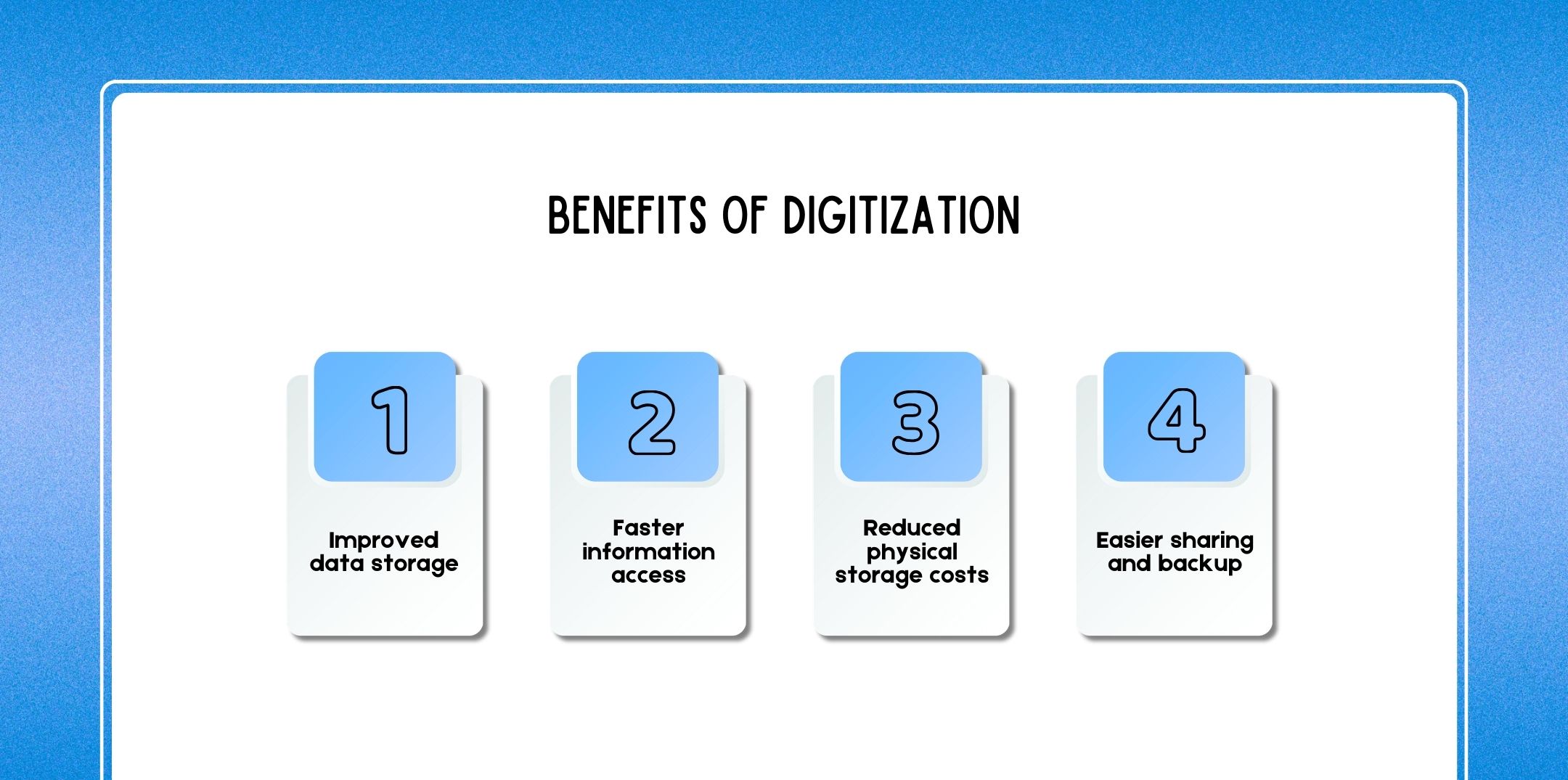
Digitization offers numerous benefits for both individuals and organizations. Therefore, many companies consider it an essential first step in their digital strategy.
Digital files can be stored in databases, cloud storage systems, or digital archives. As a result, organizations can manage large volumes of information more efficiently.
Unlike physical files stored in cabinets or warehouses, digital files can be retrieved instantly using search functions. Consequently, employees save time and increase productivity.
Maintaining physical storage facilities for paper documents can be expensive. However, digitization significantly reduces the need for physical space.
Digital files can be easily shared via email, collaboration platforms, or cloud storage systems. Additionally, they can be backed up automatically to prevent data loss.
Therefore, digitization improves both accessibility and reliability.
Although digitization and digitalization sound similar, they represent different stages of digital progress.
Below is a comparison highlighting the key differences.
| Feature | Digitization | Digitalization |
| Definition | Converting analog data into digital format | Using digital technologies to transform processes |
| Scope | Data conversion | Business transformation |
| Complexity | Low | High |
| Example | Scanning documents | Automated digital workflows |
| Business impact | Improves accessibility | Enables innovation and new models |
In summary, digitization focuses on converting information, whereas digitalization focuses on using that information to improve processes and services.
Digitization and digitalization are not isolated concepts. Instead, they form part of a progression model that organizations follow during digital maturity.
Typically, companies evolve through three major stages.
The first stage involves converting physical data into digital formats.
Examples include scanning documents, digitizing customer records, and converting physical media into digital files.
At this stage, the main goal is data accessibility.
Once data becomes digital, organizations can start using technology to improve workflows.
For example:
As a result, operations become faster, more efficient, and less dependent on manual work.
The final stage goes beyond process improvement. Digital transformation involves redesigning entire business models using digital technologies.
Examples include:
Consequently, organizations create new revenue streams and competitive advantages.
Digitization and digitalization are transforming nearly every industry. Let’s examine how different sectors use these technologies.
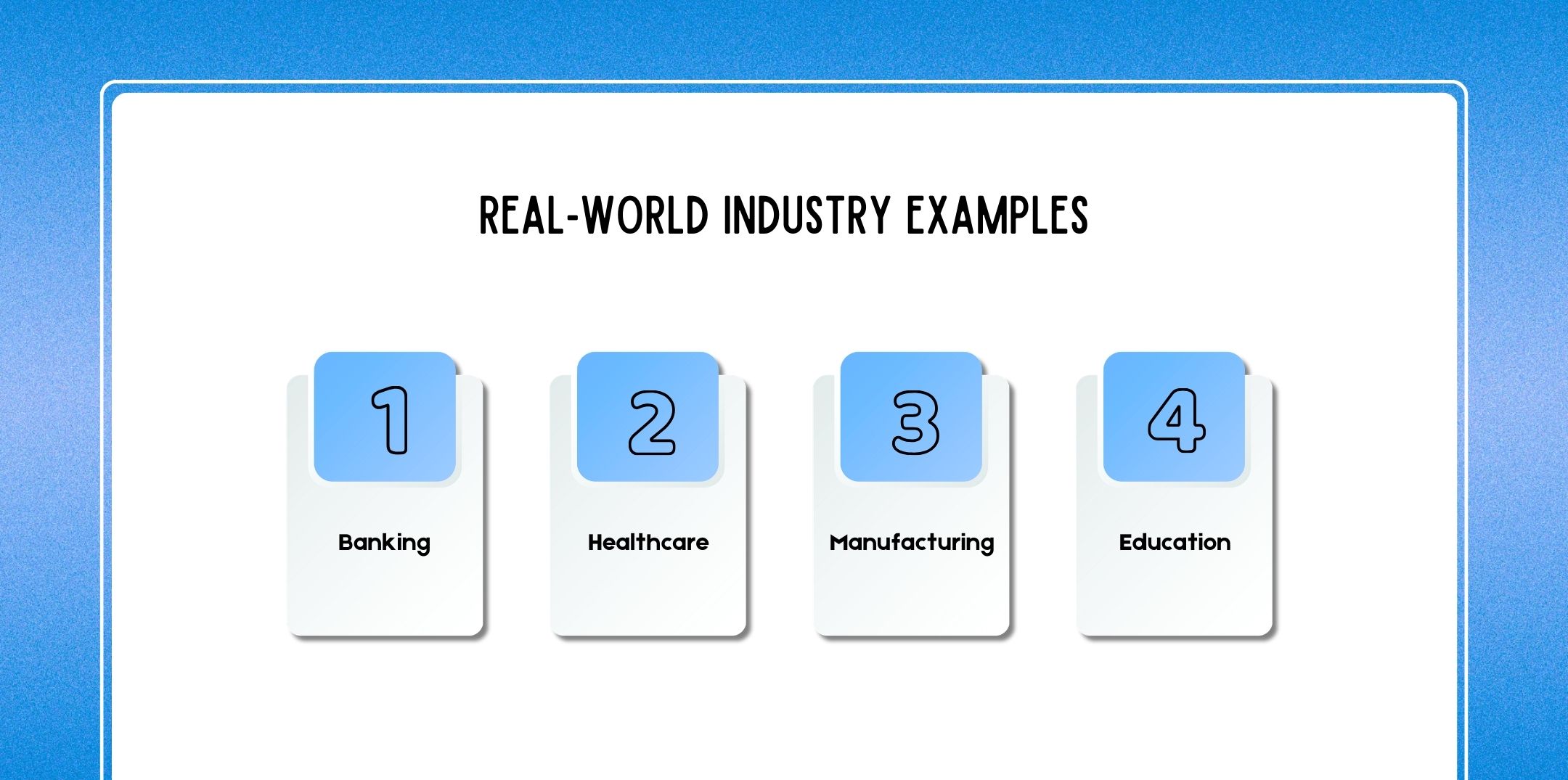
The banking industry provides a clear example of digital evolution. Initially, banks digitized paper records such as account information and transaction histories.
Later, digitalization enabled services such as:
Today, many banks operate fully digital services, offering instant payments and digital financial management tools.
Healthcare organizations began by digitizing medical records. Electronic Health Records (EHR) replaced paper patient files.
Subsequently, digitalization introduced technologies like:
As a result, healthcare providers can deliver faster and more efficient patient care.
Manufacturing companies use digitization to convert design documents and production data into digital formats.
However, digitalization goes further by introducing:
Consequently, manufacturers increase efficiency while reducing downtime.
Educational institutions initially digitized textbooks, research papers, and academic records.
Later, digitalization enabled:
Therefore, education has become more accessible and flexible.
Also Check: ViralTips Online: The Ultimate 2026 Guide To Creating Content That Truly Goes Viral
Several advanced technologies power digitalization initiatives. Some of the most important include:
Together, these technologies allow organizations to create efficient digital ecosystems.
Adopting digital strategies can be challenging. However, following best practices can increase success.
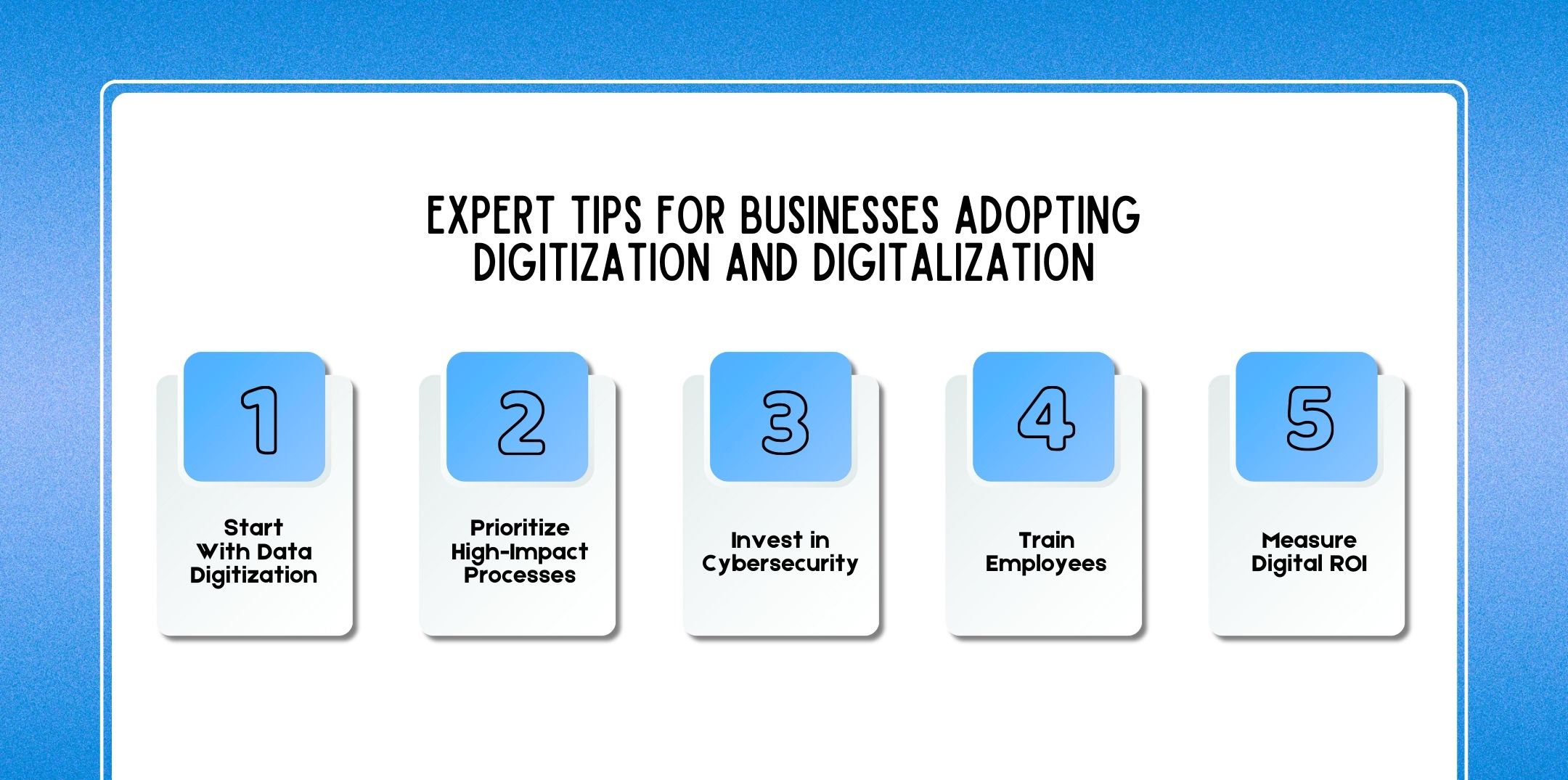
Before implementing advanced technologies, businesses should digitize existing records and data sources. Without digital data, automation and analytics cannot function effectively.
Instead of digitizing everything at once, organizations should focus on processes that deliver the greatest benefits. For example, customer service and supply chain operations often provide strong returns.
As businesses rely more on digital systems, cybersecurity becomes critical. Organizations must protect sensitive data using encryption, monitoring tools, and secure networks.
Digital transformation requires skilled employees. Therefore, companies should invest in training programs that teach digital tools and technologies.
Finally, businesses should track the impact of digital initiatives.
Key performance indicators may include:
Tracking these metrics ensures that digital investments deliver measurable value.
Despite the benefits of digitization and digitalization, many organizations encounter challenges.
Some common mistakes include:
Therefore, successful digital strategies require careful planning and execution.
The future of digitization and digitalization will be shaped by emerging technologies.
Several trends are already influencing this evolution.
As a result, companies that embrace these technologies will remain competitive in the digital economy.
Here are a few questions and queries on the topic of digitization vs digitalization that others have asked, and it might be helpful for you as well.
Digitization converts analog data into digital format, while digitalization uses digital technologies to improve or transform processes.
No. Digitization is the first step, while digital transformation involves major organizational change.
It improves data accessibility, storage, and operational efficiency.
Online banking, automated manufacturing systems, and digital marketing platforms.
No. Digitalization requires digital data, which comes from digitization.
AI, cloud computing, IoT, big data analytics, and automation tools.
It varies by organization and may take months or several years, depending on complexity.
Healthcare, finance, manufacturing, retail, and logistics.
Costs vary, but many companies adopt cloud-based solutions to reduce investment.
Data analytics, cybersecurity, cloud computing, and automation expertise.
When it comes to digitization vs digitalization, they are the fundamental concepts in the modern digital economy. Although they are closely related, they represent different stages of technological progress.
Digitization focuses on converting analog data into digital formats. Meanwhile, digitalization leverages digital data to improve processes, automate operations, and create new business opportunities.
Therefore, businesses must understand both concepts to build effective digital strategies.
By starting with digitization, adopting digital technologies, and gradually transforming business models, organizations can achieve sustainable growth in an increasingly digital world.
Ultimately, the companies that successfully combine data, technology, and innovation will lead the next wave of digital transformation.

Nabamita Sinha loves to write about lifestyle and pop-culture. In her free time, she loves to watch movies and TV series and experiment with food. Her favorite niche topics are fashion, lifestyle, travel, and gossip content. Her style of writing is creative and quirky.