What Does A Computer Programmer Do: Essential Guide
Barsha Bhattacharya, 11 minutes ago

The modern creator economy operates on a system of complex and real-time programmatic auctions.
For digital video creators, independent production houses and media entrepreneurs, building a sustainable brand requires a clear understanding of financial realities.
Many newcomers enter the market with a basic, straightforward question: how much does YouTube pay per view?
The direct, technical answer is that YouTube does not actually pay creators on a flat “per-view” basis for their videos.
Instead, the platform’s parent company, Google, runs a highly dynamic advertising marketplace.
This calculates earnings based on ad impressions, viewer geography, and audience demographics.
To turn a channel into a reliable business, you have to look past casual assumptions.
This comprehensive guide moves past the basic definitions of video metrics. It will go on to provide a realistic breakdown of the platform’s payment architecture and the key variables.
These dictate your actual earnings and the structural metrics required to scale your revenue.
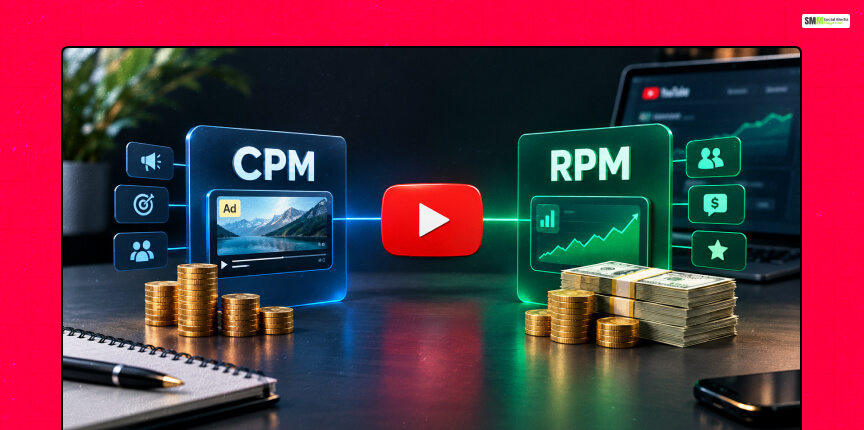
To figure out your actual video earnings, you must master two foundational metrics that track how money flows through the YouTube Partner Program (YPP).
These metrics separate raw ad costs from the actual money deposited into a creator’s bank account.
CPM can be regarded as the total amount of money advertisers are willing to pay to display one thousand ads on your video content.
The “Mille” stands for the Latin word for one thousand.
Crucially, CPM is considered a gross metric that tracks advertiser demand instead of per
RPM is the absolute gold standard metric for tracking your actual earnings.
It measures the net revenue a creator earns per one thousand views across their entire channel.
Unlike CPM, your RPM calculation includes the platform’s structural 45% revenue cut.
Moreover, it factors in alternative monetization avenues like channel memberships, Super Chats, and premium viewer impressions.

Individual channel payouts fluctuate constantly on the basis of changing niche variables.
However, tracking historical averages provides an essential baseline for financial planning.
On a global average, a monetized video yields a total net return between $1.00 and $10.00 per 1,000 views (RPM).
This translates to a micro-payment of roughly $0.001 to $0.01 per individual view.
The table below outlines how these average RPM ranges distribute across different traffic milestones. Let us assume standard monetization features are fully active.
| Channel View Milestone | Average Per-View Payout | Lower-Bound Net Revenue (Low-CPM Niche) | Upper-Bound Net Revenue (High-CPM Niche) |
|---|---|---|---|
| 1,000 Views | $0.001 to $0.01 | $1.00 | $10.00 |
| 10,000 Views | $0.001 to $0.01 | $10.00 | $100.00 |
| 100,000 Views | $0.001 to $0.01 | $100.00 | $1,000.00 |
| 1,000,000 Views | $0.001 to $0.01 | $1,000.00 | $10,000.00 |

Two identical channels pulling the exact same view count can experience radically different financial payouts.
Your programmatic valuation is directly shaped by specific viewer demographics and content category choices.
The physical country where your viewer hits the play button completely dictates your video’s ad revenue.
Advertisers are willing to pay premium rates to target audiences in wealthy nations with high disposable income.
Viewers watching from countries like Australia, the United States, or Canada trigger exceptionally high CPM rates.
For instance, Australia leads with an $11.95 average RPM, whereas the USA has an average $10.81 RPM. On the other hand, Canada offers a $9.62 average RPM.
Conversely, traffic originating from developing digital advertising markets like India offers $0.70 to $0.83 RPM. Indonesia offers $0.30 to $1.00 RPM.
These nations yield significantly lower advertising rates due to localized market spending constraints.
The specific topic of your video alters your value in the ad auction. Advertisers fight aggressively to display their banners on content that attracts high-value customers.
Here is a dataset on channels that will allow you to have a better understanding.
| Content Sectors Based on CPM | Content Niches | Average RPM |
|---|---|---|
| High-CPM Content Sectors | Personal Finance | $4.95 to $16.50 RPM |
| Legal and Business Advice | $5.00 to $15.00 RPM | |
| B2B Tech or AI | $4.00 to $11.00 RPM | |
| Low-CPM Content Sectors | Vlogs | $1.00 to $4.00 RPM |
| Gaming Channels | $0.88 to $3.30 RPM |
Channels dedicated to Personal Finance, Legal and Business advice, and B2B Tech or AI command massive payouts.
This spike happens because a viewer looking at a banking or enterprise software tutorial is highly likely to make a high-value commercial purchase.
As a result, this makes them valuable to brands.
On the other hand, general entertainment channels, vlogs and gaming feeds struggle with lower baseline rates.
That is due to their broad, low-intent demographics.
While these niches can attract millions of views with ease, the individual view value is exceptionally low.
Accordingly, you must rely purely on massive traffic volume to generate stable revenue.

The physical layout and length of your video assets completely alters the way the platform calculates your monthly payouts.
Content creators must split their production strategies to match these distinct system engines.
Traditional horizontal videos remaining past the 8-minute mark tend to enjoy a massive mechanical advantage of mid-roll ads.
When a video hits this specific duration barrier, creators can manually insert multiple ad breaks throughout the timeline.
This increased ad real estate multiplies your potential ad impressions per view. Furthermore, this structurally raises your RPM well above shorter videos.
Short-form vertical video monetization operates on a completely different, decentralized framework.
Instead of a direct split on an individual video, the platform pools all global ad revenue generated from the Shorts Feed every month.
The platform uses this pool to pay music licensing fees first, and then distributes a share to creators based on their percentage of total channel views.
The Shorts Feed serves ads between videos rather than directly on them.
As a result, the average payout is exceptionally thin, with a median global RPM of just $0.03 to $0.20 per 1,000 views.

Relying entirely on programmatic ad placement payouts is an unstable way to build a digital business.
High-earning content creators treat AdSense revenue as a minor baseline, actively building alternative monetization pipelines directly into their channel architectures.
By placing tracking links for physical products, online courses, or software tools directly into your video descriptions, you can generate passive revenue streams.
Moreover, these bypass video view counts completely.
A specialized channel with only 5,000 highly targeted views can easily out-earn a million-view entertainment channel. That is, if a fraction of that audience clicks an affiliate link to purchase a high-ticket software tool.
Once a channel establishes clear authority within a specific industry, brands will pay flat premium fees. This allows them to secure a 30-second dedicated integration slot inside a video.
Additionally, these direct contracts let creators secure predictable, flat-rate integration fees that remain protected from seasonal ad fluctuations or sudden algorithm shifts.
Thus, masking the mechanics of video monetization proves that building digital revenue is less about chasing empty view counts. Instead, it is about making a smart, strategic play for high-value audiences.
The media landscape has evolved past the point where raw traffic volume automatically guarantees financial stability.
First of all, you must target premium Tier 1 geographic regions and choose an industry niche with high advertiser demand. Then, focus on protecting your cash flow through affiliate structures and brand sponsorships.
By doing so, you can successfully fix the broken lines of erratic platform pay. It takes daily production consistency and focused audience targeting.
However, it allows your digital studio to step out of the programmatic crossfire.
Thus, you get your revenue stability, creative control, and financial peace of mind back.

Sibashree has been into SEO and eCommerce content writing for more than 9 years. She loves reading books and is a huge fan of those over-the-top period dramas. Her favorite niches are fashion, lifestyle, beauty, traveling, relationships, women's interests, and movies. The strength of her writing lies in thorough research backing and an understanding of readers’ pain points.