
How Long Can A Reel Be On Instagram In 2026? What 10 Years On This Platform Has Taught Me?
sibashree bhattacharya, 3 days ago
If you use Gmail regularly, you’ve probably come across alarming stories about a google gmail data breach at some point in the last few years. Headlines claiming millions of Gmail accounts were hacked or leaked online have become increasingly common, leaving many users confused and concerned about whether their personal information is actually safe.
The truth is more complicated than most headlines suggest.
In many of these incidents, Google’s own systems were never directly hacked. Instead, attackers found other ways to steal login credentials through phishing scams, malware infections, password reuse, and third-party security failures. Even though the company’s infrastructure remained secure in most cases, the risks to users were still very real.
That’s why the discussion around the google gmail data breach incidents matters. Once cybercriminals gain access to someone’s email account, they can potentially access banking alerts, cloud storage, private conversations, social media accounts, and password reset links tied to other services.
Over the years, several major security incidents involving Gmail credentials have exposed hundreds of millions of records online. Some were exaggerated by media coverage, while others represented serious cybersecurity threats affecting users around the world.
Understanding what actually happened can help you better protect your own accounts and avoid becoming an easy target for future attacks.
The phrase “google gmail data breach” is often used broadly, even though the incidents themselves were very different from one another. Some involved malware stealing passwords directly from infected devices, while others involved exposed databases or phishing attacks targeting users.
Here’s a detailed breakdown of the biggest Gmail-related security incidents over the years and what really happened behind the scenes.
In September 2014, one of the first major Gmail credential leaks made global headlines after nearly five million Gmail usernames and passwords appeared on a Russian online forum associated with cybercriminal activity.
At first, many users believed Google itself had suffered a massive hack.
However, investigators later found no evidence that Google’s internal systems had been compromised. According to security researchers, the leaked credentials were collected gradually through phishing campaigns, malware, and breaches involving unrelated websites where users reused the same passwords they used for Gmail.
Even though Google’s servers were not directly breached, the incident still became one of the earliest major google gmail data breach scares because millions of real login credentials were suddenly circulating online.
Google responded quickly by locking affected accounts and requiring users to reset their passwords before regaining access.
The event also highlighted a serious cybersecurity problem that still exists today: password reuse. Many people continue using identical passwords across multiple websites, which means a breach on one platform can easily lead to compromised email accounts elsewhere.
One of the biggest stories connected to the google gmail data breach narrative emerged in 2025 after cybersecurity researcher Troy Hunt added a massive collection of stolen credentials to the breach notification platform Have I Been Pwned.
The database reportedly contained around 183 million unique email addresses and passwords collected from infected devices worldwide.
Naturally, Gmail accounts made up a significant portion of the exposed credentials.
As media outlets began reporting on the story, many articles described it as a direct Gmail breach. Google publicly disputed those claims, explaining that the data did not come from hacked Google servers.
Instead, the credentials were harvested using infostealer malware.
Infostealers are dangerous malicious programs that secretly run on infected computers and devices. Once installed, they can quietly collect saved browser passwords, login sessions, autofill information, cookies, and other sensitive credentials without the victim realizing anything is wrong.
Cybercriminal groups often combine these stolen credentials into enormous databases that are later sold or traded online.
Researchers later discovered that many of the credentials in the 2025 collection had already appeared in older breach databases. However, millions of records were still newly exposed, making the incident significant despite the confusion surrounding the reporting.
The event showed how malware infections have become one of the biggest contributors to modern credential theft.
Another incident connected to the broader google gmail data breach discussion involved a security issue tied to Salesforce systems used for advertising and communication operations.
This attack looked very different from a traditional password leak.
Hackers reportedly used social engineering techniques to trick an employee into installing malicious software during a voice phishing attack, sometimes called “vishing.”
After gaining access, attackers compromised OAuth authentication tokens connected to third-party integrations.
OAuth tokens are especially valuable because they can provide continued access to connected applications without requiring passwords again.
The attackers primarily gained access to business contact information rather than ordinary Gmail inboxes. However, the stolen information was later used in highly convincing phishing campaigns targeting users and organizations.
In response, affected integrations were disabled, compromised tokens were revoked, and administrators were alerted about the risks.
This incident reinforced an important lesson: modern attackers often target people rather than systems because human error is usually easier to exploit than advanced technical defenses.
In early 2026, another major event added fuel to ongoing google gmail data breach concerns after cybersecurity researcher Jeremiah Fowler discovered a massive unsecured database online.
The exposed database reportedly contained around 149 million login records, including approximately 48 million Gmail credentials.
What made the situation especially alarming was the complete lack of security protecting the database. There was reportedly no password protection, no encryption, and no access restrictions at all.
Anyone who discovered the database could access its contents freely through a web browser.
Researchers believe the credentials were collected through malware infections rather than through a direct attack on Google’s infrastructure.
Even more concerning, the database appeared to be actively growing while it remained publicly accessible online, suggesting new stolen credentials were continuously being added.
Attempts were made to contact the database owner, but after receiving no response, the issue was escalated to the hosting provider.
Unfortunately, the database reportedly remained exposed for weeks before finally being taken offline.
During that time, nobody knows how many cybercriminals may have downloaded copies of the data.
One reason the google gmail data breach stories became so confusing is because there was no single attacker or organization behind all the incidents.
Each event involved different methods and different threat actors.
Some incidents resulted from phishing attacks. Others involved malware infections, social engineering campaigns, or poorly secured online databases.
Despite their differences, these incidents shared one important pattern:
Most attackers focused on users rather than trying to break into Google itself.
That approach makes sense from a criminal perspective. Attacking individual users is often easier than attempting to bypass the sophisticated security protections surrounding major technology companies.
Cybercriminals know many users still reuse passwords, click suspicious links, install unsafe software, or ignore security warnings. Exploiting those behaviors is often much simpler than launching a direct attack against a company like Google.
The scale of these incidents was enormous.
Here’s a simplified overview of the largest events connected to the google gmail data breach discussions:
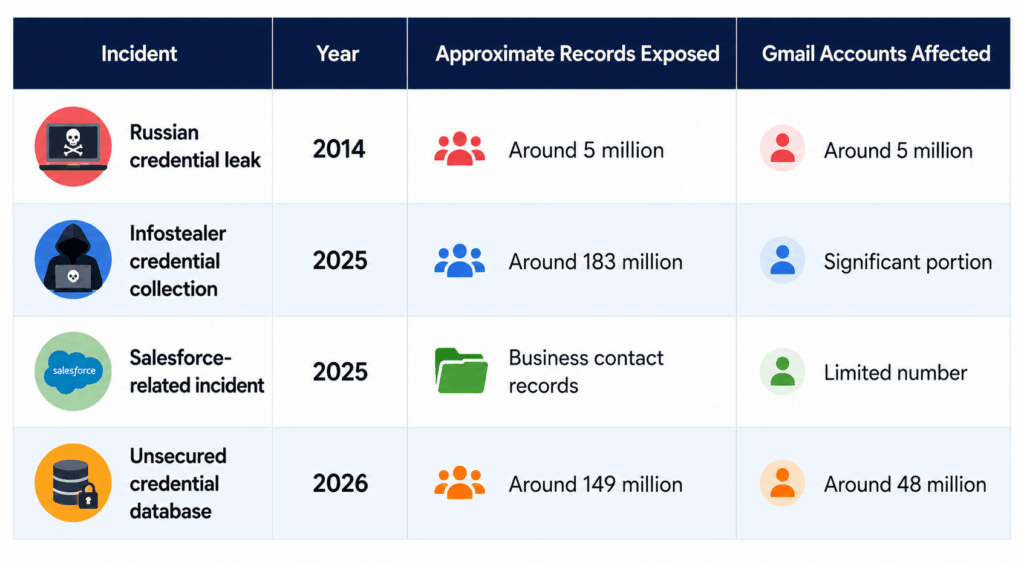
Even though most of these incidents did not involve a direct breach of Google’s systems, they still exposed huge amounts of sensitive user data.
Each google gmail data breach incident became public in a different way.
The 2014 credentials appeared on a public cybercrime forum.
The 2025 infostealer dataset became known after researchers analyzed and uploaded the records to breach notification services.
The Salesforce-related issue was discovered internally after suspicious activity was detected.
The unsecured database in 2026 was uncovered during internet-wide security scans looking for exposed systems.
Responses to these incidents typically included:
However, once stolen credentials enter underground cybercriminal networks, it becomes extremely difficult to remove them permanently.
If you’re concerned about a potential google gmail data breach affecting your account, one of the easiest things you can do is check your email address using breach notification platforms like Have I Been Pwned.
You simply enter your Gmail address to see whether it appears in publicly known breach databases.
If your account appears in a breach database, don’t panic — but don’t ignore it either.
It doesn’t necessarily mean someone successfully accessed your account, but it does mean your credentials were exposed somewhere online, and you should secure your account immediately.
The ongoing google gmail data breach stories highlight just how important basic account security has become.
Here are some of the most important steps you should take to protect your Gmail account moving forward.
Google allows users to review recent login activity and connected devices.
Take time to check for:
If anything looks unusual, act immediately.
Many people remain signed into Gmail on old devices they no longer use.
Review your active devices list regularly and remove anything unfamiliar or unnecessary.
Older devices can become security risks if they’re lost, stolen, or compromised later.
Third-party applications connected to your Google account may continue accessing information even after a password change.
Review every connected app carefully and revoke access for anything you don’t recognize or no longer use.
Compromised OAuth access has become increasingly common in modern cyberattacks.
Attackers sometimes create hidden forwarding rules after compromising an account.
These rules can secretly forward emails elsewhere or hide important security notifications from the account owner.
Carefully review your:
Remove anything suspicious immediately.
One of the best ways to secure your account against future google gmail data breach risks is enabling two-factor authentication.
Even if hackers steal your password, they’ll usually still need access to your secondary authentication method before logging in.
Authentication apps, security keys, and passkeys generally provide stronger protection than SMS verification.
Passkeys are becoming especially popular because they offer both stronger security and easier logins.
Password reuse remains one of the biggest reasons credential leaks continue causing damage years after the original exposure.
If you use the same password across multiple websites, a breach on one service can potentially compromise all your accounts.
Using a password manager can make it much easier to generate and store strong, unique passwords for every account.
Most modern browsers and password managers now include built-in password monitoring tools.
These tools can warn you about:
Paying attention to these warnings can help reduce your chances of future compromise.
One thing many people overlook after a google gmail data breach scare is how much personal information about them is already available online.
Data brokers and marketing companies often collect information such as:
Cybercriminals can combine that information with leaked credentials to launch more convincing phishing scams or identity theft attacks.
Reducing your digital footprint won’t eliminate all risks, but it can make you a less attractive target.
The ongoing headlines surrounding the google gmail data breach incidents can sound terrifying, but the reality is usually more complicated than the headlines imply.
In most cases, attackers did not directly hack Google’s infrastructure. Instead, they relied on phishing scams, malware infections, credential theft, password reuse, and social engineering tactics targeting users themselves.
Still, the risks for ordinary users remain serious.
A compromised Gmail account can expose private conversations, financial details, personal documents, cloud storage accounts, and access to countless connected services.
That’s why taking account security seriously is more important than ever.
Using strong passwords, enabling two-factor authentication, reviewing account activity regularly, monitoring breach notifications, and staying cautious around suspicious emails can dramatically reduce your chances of becoming a victim.
As cybersecurity threats continue evolving, proactive security habits remain your best defense against future google gmail data breach incidents and other online threats.

Barsha is a seasoned digital marketing writer with a focus on SEO, content marketing, and conversion-driven copy. With 8+ years of experience in crafting high-performing content for startups, agencies, and established brands, Barsha brings strategic insight and storytelling together to drive online growth. When not writing, Barsha spends time obsessing over conspiracy theories, the latest Google algorithm changes, and content trends.

sibashree bhattacharya, 3 days ago

Subham Kamila, 3 days ago