How To Create a Social Media Marketing Plan That Actually Drives Results In 2026
sibashree bhattacharya, 5 hours ago
If you have spent any time in artist Facebook groups or Instagram DMs, you have heard the same question a hundred different ways. “Where should I actually sell my art online?”
The honest answer is that the platform you sell on matters almost as much as the platform you promote on. That is because the two have to work together.
The U.S. online art sales industry is now worth an estimated $4.2 billion. Moreover, it is spread across nearly 3,900 businesses ranging from boutique galleries to massive print-on-demand operations (IBISWorld, 2026).
That’s a lot of competition for attention. That is exactly why you cannot separate a marketplace choice from a marketing choice.
Below, I am breaking down the strongest options by category and what they actually cost. Most importantly, I will explain how to pair each one with the promotion strategy that gets it seen.
Before picking a platform, look at what you will actually keep after a sale.
Commission structures vary wildly, and a “free” platform is not always the cheapest one once you factor in ad spend to get discovered.
| Platform | Commission | Recurring Fee | Category | Best Fit |
|---|---|---|---|---|
| Foundmyself | 0% | Free / $9–$16 mo | Original art marketplace | Artists who want to keep 100% and run their own site |
| Etsy | ~6.5% + processing | Free (optional $10 Plus) | Handmade marketplace | Broad reach for handmade, prints, and decor |
| Saatchi Art | 40% | Free | Curated marketplace | Emerging artists chasing global exposure |
| Singulart | 50% | $29–$149 mo tiers | Curated gallery | Established artists with exhibition history |
| Artfinder | 40–45% | $14–$40 mo | Curated marketplace | Artists who want managed shipping |
| Fine Art America | 0% on your markup | Free / $30 yr | Print-on-demand | Photographers and digital artists |
| Redbubble | 20–50% tiered | Free | Print-on-demand | High-volume digital and sticker designs |
| eBay | ~13–14% all-in | Free (basic) | General marketplace | Auction-style and search-driven reach |
Figures reflect published rates as of early-to-mid 2026 and can change; always confirm current terms before listing.
Here is the mindset shift I try to get every artist I work with to make. A marketplace listing is just a landing page. It doesn’t drive its own traffic and your social presence does.
So before you pick a platform, ask what kind of content it lets you repurpose.
A platform with strong native discovery tools saves you promotional work. One without means every sale has to be dragged in from Instagram, Pinterest, or TikTok yourself.
These are built for one-of-a-kind paintings, sculptures, and limited editions. Additionally, the category where your personal brand and social following matter most.
That is because buyers often pay for the story behind the piece as much as the piece itself.
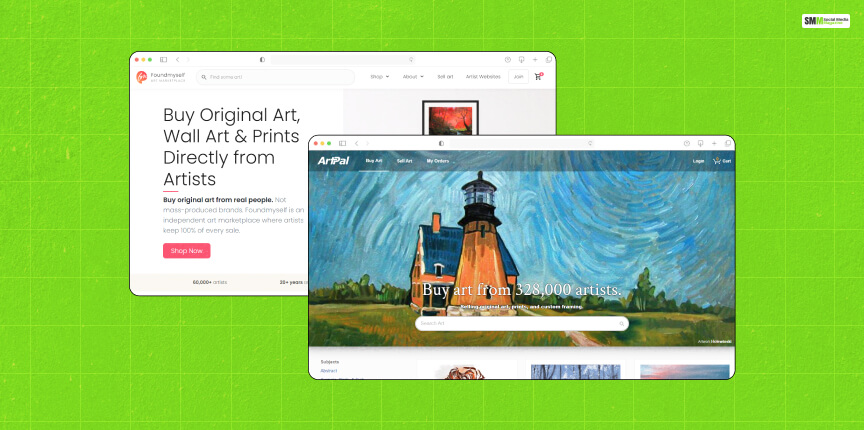
Foundmyself and ArtPal both let artists list original work without taking a cut of the sale.
Foundmyself has operated on this model since 2003 and pairs its free or paid gallery listings with verified placement on Pinterest and Google’s shopping surfaces.
Functionally, it gives your listings a second discovery channel beyond the marketplace itself.
For a social strategy, that matters. Moreover, it means a well-optimized Foundmyself listing can show up in Pinterest search results without you lifting a finger. This is worth pairing with an active Pinterest board of your own work.
The tradeoff on zero-commission platforms is smaller built-in audiences than the big curated names. Thus, plan on doing more of your own promotional lifting through Instagram Reels, Pinterest pins, and email.
If you would rather trade commission for marketing muscle, curated platforms take 40–50% but handle collector outreach, logistics, and often paid advertising on your behalf.
Saatchi Art alone lists over a million artworks from roughly 110,000 artists. Instead of just being present on the platform, visibility still depends heavily on your own keyword strategy and photography quality.
Singulart and Artfinder add subscription tiers on top of commission. Accordingly, the math only works if your sales volume is consistent enough to offset the monthly cost.
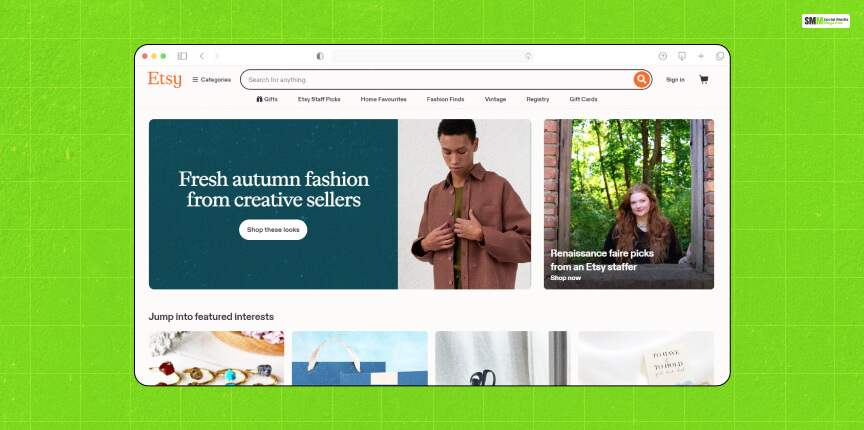
Etsy remains one of the largest general marketplaces for creative goods, with nearly 90 million active buyers.
Fees stack up to roughly 10–15% of a sale once you add the transaction fee, listing fee, and payment processing. In addition, you can climb higher if a sale comes through Etsy’s Offsite Ads.
The advantage is built-in buyer intent: people arrive already searching for art, prints, or handmade goods, which lowers the promotional lift compared to a standalone site.
For digital artists, illustrators, and photographers, print-on-demand (POD) sites turn a single file into ongoing passive sales without inventory or shipping.
The margins per sale are thinner, but the content strategy is simpler: post once, sell repeatedly.
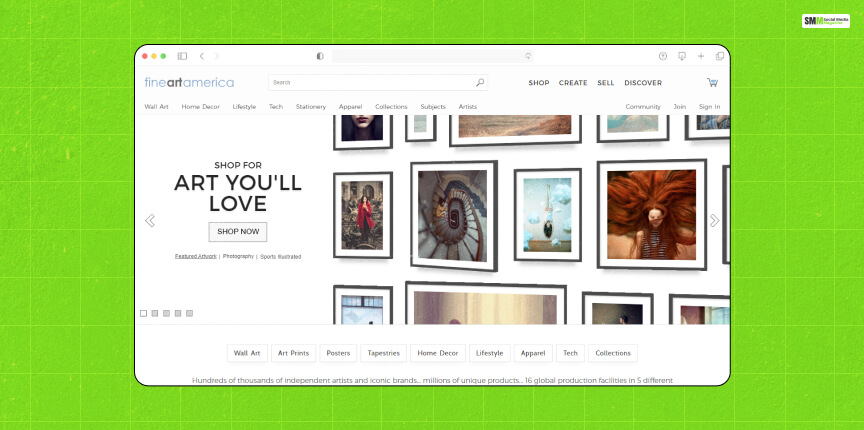
Fine Art America lets you set your own markup above their production cost and keeps your take at 100% of that markup, with 16 global fulfillment centers handling logistics.
The $30/year Premium tier unlocks a personal artist website and AR preview tools. If you’re funneling Instagram or TikTok traffic to a dedicated storefront, both of these are worth having.
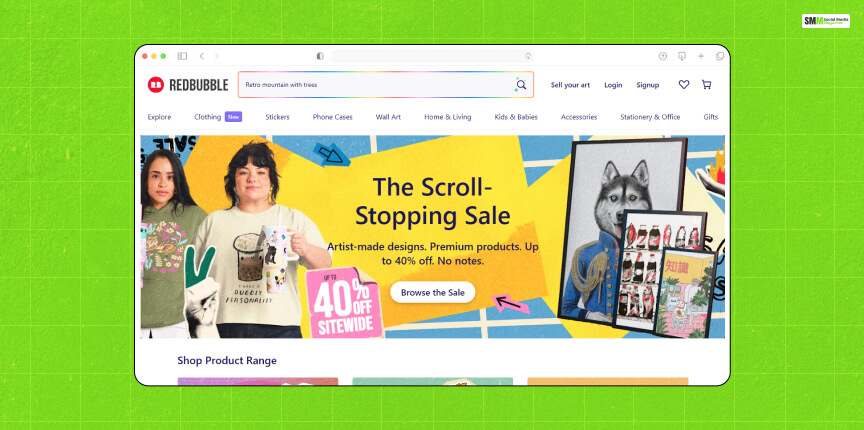
Redbubble changed its fee model on September 1, 2025, moving to a tiered structure based on account performance.
Standard sellers now pay a 50% platform fee on earnings, Premium accounts pay 20%, and only top-performing Pro accounts pay nothing.
There’s also a 50% “excess markup fee” on any margin above 20%, which makes pricing strategy far more important than it used to be.
For artists relying on Redbubble’s organic search traffic, that’s a meaningful shift worth factoring into 2026 pricing decisions.
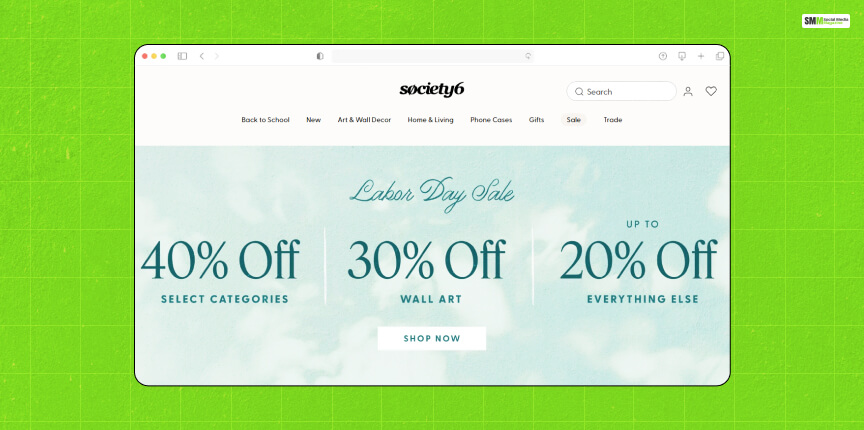
Society6 pivoted in 2025 from an open, subscription-based model to a smaller, curated roster with a fixed 5–10% royalty and no artist control over pricing.
New shop applications are currently closed while the platform rebuilds its “Artist Studio” system, so it’s more of a watch-and-wait channel than an active option right now.
eBay is not art-specific. However, its scale makes it worth a mention.
That is especially after a 2026 fee adjustment moved several art categories to a 12.7–13.6% final value fee depending on subscription tier.
Combined with payment processing, the all-in cost usually lands around 14–15%, which is competitive against curated galleries charging 40% or more.
eBay also rolled out expanded shipping-carrier integration and discounted international labels in 2026, lowering the logistics barrier that used to make cross-border art sales a headache.
This is the part most “where to sell art” guides skip, and it’s the part I spend the most time on with clients.
A marketplace listing without a promotion plan behind it is a bet on algorithmic luck.
These options work best for original-art marketplaces like Foundmyself and Saatchi Art. This is because buyers browsing those platforms are already in a discovery, aesthetic-driven mindset.
Post process videos and behind-the-scenes content, then link directly to your listing in bio links or Pinterest pin destinations.
TikTok is increasingly a sales driver for print-on-demand and lower-price-point work, particularly time-lapse “painting process” clips.
These perform well because they satisfy the platform’s current emphasis on watch-through and rewatch behavior rather than quick likes.
Etsy and eBay benefit less from off-platform promotion and more from on-platform SEO.
Since both platforms already have strong internal search traffic, titles, tags, and descriptions should match what buyers are actually searching for.
| Cost Type | Range | Notes |
|---|---|---|
| Zero-commission listing | $0 | Foundmyself, ArtPal, Fine Art America base tier |
| Curated gallery commission | 40–50% | Saatchi Art, Singulart, UGallery, Artfinder |
| General marketplace fees | 10–15% all-in | Etsy, eBay |
| POD platform fee | 0–50% tiered | Redbubble; varies by account tier |
| Monthly subscription (curated) | $14–$149 | Artfinder, Singulart tiers |
Most working artists I know sell in two or three places at once rather than betting everything on one platform.
Generally, a reasonable starting split looks like:
Layer social promotion such as Instagram and Pinterest for originals, TikTok for process content, and lower-cost prints on top of all three.
In this way, you’re not depending on any single platform’s algorithm or fee structure to keep your income steady.
Figuring out where to sell artwork online is not about finding a single magic platform. Instead, it is about understanding how your art, your pricing, and your marketing strategy connect.
A $0-commission site is incredible for keeping your margins high, but only if you have the social media engine to drive your own traffic.
Conversely, a high-commission curated gallery can introduce you to global collectors, but you pay for that privilege with half of your check.
The most successful artists in 2026 do not put all their eggs in one basket. By building a diversified sales funnel and combining the broad marketplace search power of Etsy or eBay, the high-end appeal of curated galleries.
Additionally, with the passive reach of print-on-demand, you can create a resilient creative business that is not at the mercy of a single platform’s algorithm.
Match your storefront to your strengths, stay consistent with your promotion, and let the platforms do what they do best.

Sibashree has been into SEO and eCommerce content writing for more than 9 years. She loves reading books and is a huge fan of those over-the-top period dramas. Her favorite niches are fashion, lifestyle, beauty, traveling, relationships, women's interests, and movies. The strength of her writing lies in thorough research backing and an understanding of readers’ pain points.

sibashree bhattacharya, 5 hours ago

sibashree bhattacharya, 6 hours ago

sibashree bhattacharya, 3 days ago