How To Create a Social Media Marketing Plan That Actually Drives Results In 2026
sibashree bhattacharya, 4 hours ago
The biggest difference between social media accounts that grow and those that stall isn’t budget or creativity.
It comes down to whether you have a clear blueprint driving your content, or if you’re just throwing posts out there because it happens to be Tuesday.
Treating your brand’s channels like a checkbox chore makes it incredibly hard to see real momentum.
Today, 5.66 billion people are active on social media globally. As you can see, the digital space is incredibly crowded. In addition, the average person splits their attention across nearly seven different platforms every single month.
Because everyone’s attention is so fragmented, a passive “post and pray” approach no longer cuts it.
If you want your content to move the needle, you have to look past the daily content calendar.
You need to master how to create a social media marketing plan that acts as a true strategy. This will be one that maps your audience research directly to actual business objectives.
Below is a practical, step-by-step framework for building a strategy from scratch.
Updated specifically for how platforms and algorithms behave right now, this guide gives you a repeatable blueprint so you can learn how to create a social media marketing plan that turns raw views into real, measurable ROI.
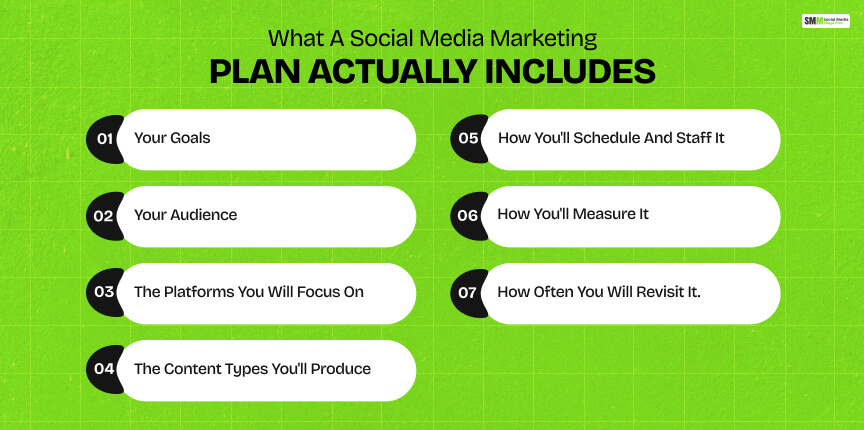
A real plan is a document, not a vibe.
At minimum, it should be able to define:
Skip any one of those pieces, and you end up with a content calendar that looks busy but cannot tell you whether it’s working.
Remember, learning how to create a social media marketing plan and managing a content calendar are two completely different tasks that often get confused.
A content calendar is a scheduling tool. Moreover, it shows what’s posted when.
On the other hand, a marketing plan is the strategy behind it. Those are goals, audience research, platform selection, and the KPIs used to judge whether the calendar is actually working.
Writing down vague goals like “let’s grow our audience” gives you absolutely nothing to build a strategy around.
Instead, force yourself to define what success actually looks like before you ever hit post. You need goals that are hyper-specific and tied to a deadline.
For example, don’t just say you want more followers. Say something like: “We want to grow our Instagram following by 20% over the next six months to get our brand in front of more people.”
Now you know exactly what kind of content to make, and you’ll know exactly whether it worked or failed.
The trick is to match your goals to where your audience is at in their journey. If you don’t, you’ll end up wasting time chasing the completely wrong numbers for what you’re actually trying to achieve:
| Funnel Stage | What You’re Optimizing For | Typical Metrics |
|---|---|---|
| Awareness | Getting seen | Impressions, reach, follower growth |
| Consideration | Getting clicked | Engagement rate, website clicks, saves |
| Conversion | Getting bought | Leads, sign-ups, purchases, CPL |
| Retention | Getting kept | Repeat engagement, referrals, CSAT |
Start with just one to three core goals. Trying to optimize for awareness, leads, and customer service all at once with the same piece of content usually means none of it performs well.
Every platform’s built-in analytics will show you exactly who is already engaging with your content. Tools like Meta Business Suite, Instagram Insights, and LinkedIn Analytics break down age brackets, top locations, and active hours.
Use this as your starting data set, instead of just guessing. Most brands see far better results focusing on one to three platforms where their target audience actually hangs out. That is, rather than stretching themselves thin across five or six.
From there, build one or two lightweight personas that describe how your audience behaves, not just who they are on paper.
For example, a persona like “checks LinkedIn before 9 AM, wants practical takeaways, and skips anything that feels like a sales pitch”. Accordingly, it gives your creative team a real person to write for.
That is a lot more useful than a boring bulleted list of age and income data.
This is where I see the most wasted budget. Brands maintain five platforms because “we should be everywhere,” spreading thin content across all of them, and wondering why nothing performs.
Platform user bases and behavior differ enough in 2026 that spreading effort evenly is almost always the wrong call.
| Platform | Approx. Monthly Active Users (2026) | Strongest For |
|---|---|---|
| 3.07 billion | Community groups, broad-reach ads | |
| 3.0 billion | Visual storytelling, Reels, shopping | |
| YouTube | 2.58 billion | Long-form and Shorts, search-driven discovery |
| TikTok | ~1.99 billion | Short-form video, trend-driven discovery |
| 1.2–1.3 billion | B2B thought leadership, recruiting | |
| 631 million | Visual discovery, evergreen product traffic | |
| X (Twitter) | ~550 million | Real-time updates, customer service |
User figures compiled from platform disclosures and 2026 industry reporting (Sprout Social; Thrive Agency; company Q1 2026 filings).
A few real examples worth studying by platform.
| Platform | Brand | Core Strategy & Execution | Key Result / Takeaway |
| Starbucks | Leans on Facebook Groups and lifestyle content. | Builds community instead of pushing straight promotions. | |
| TikTok | Chipotle | Launched the #GuacDance hashtag challenge, generating 250,000+ video submissions. | Sparked a record-breaking online ordering day via low-production, trend-native ideas. |
| X (Twitter) | JetBlue | Built a reputation for fast, personable customer service replies. | Turned a basic support channel into a powerful brand-voice asset. |
| YouTube | GoPro | Curates user-generated footage instead of relying on expensive studio productions. | Keeps content costs low while reinforcing adventure positioning. |
| IBM | Shares expert-authored articles and employee spotlights. | Positions the company as an industry thought leader rather than a regular vendor. |
Once platforms are set, define three to five recurring content pillars. These are the themes you will return to repeatedly so your feed has variety without losing focus.
A typical mix looks like educational content, entertaining or behind-the-scenes posts, user-generated content, promotional posts, and thought leadership.
From there, map a realistic posting cadence per platform rather than posting daily everywhere out of obligation:
| Platform | Reasonable Starting Cadence |
|---|---|
| 3–5 posts/week plus Stories and Reels | |
| 2–3 posts/week | |
| 3–5 posts/week | |
| TikTok | 2–4 posts/week |
| X (Twitter) | 1–3 posts/day |
| 5+ pins/week | |
| YouTube | 1 video/week or biweekly for long-form |
Repurposing stretches every piece of content further: a single blog post can become a LinkedIn article, a carousel, a short-form video script, and a Pinterest pin without starting from scratch each time.
Likes and follower counts feel good but rarely prove business value on their own. Match your KPIs to the goal you set in Step 1:
| Goal Type | Track These |
|---|---|
| Brand awareness | Reach, impressions, follower growth rate, share of voice |
| Engagement | Likes, comments, shares, saves, engagement rate |
| Leads or sales | CTR, UTM-tracked site traffic, sign-ups, cost per lead |
| Customer support | Response rate, average response time, resolution rate, CSAT |
Advertisers report an average return of roughly $5.20 for every $1 spent on social media advertising. However, that figure only means anything if you are tracking the right conversion metric for your specific goal rather than a vanity number (New Media, 2026).
Review performance monthly or quarterly, and let the data decide whether to keep, tweak, or drop a content format instead of an instinct.
Pick three to five brands that match your size, audience, or category. This is a mix of direct competitors and one or two aspirational brands worth watching.
For each, track which platforms they’re active on, how often they post, what content formats consistently get engagement, and how they handle comments and complaints.
Note that you are not copying their playbook. Instead, you are looking for:
This step did not exist in most social strategies five years ago. However, it is absolutely non-negotiable now. Platform algorithms shifted meaningfully heading into 2026. Additionally, a plan that doesn’t account for that will underperform within a quarter.
A few changes worth building into your 2026 plan specifically:
None of that means throwing out your content pillars. It means reviewing performance against these specific signals, such as save rate, share rate, and watch-through. That is doen instead of just looking at likes, when you do your monthly check-in.
A social plan is not a document you write once. Build in a monthly performance review against your KPIs, and a deeper strategy audit every six to twelve months where you revisit.
That is, whether your original goals, platform mix, and content pillars still match your actual results and business priorities.
Monthly for performance data against your KPIs, and a deeper full-strategy audit every six to twelve months to confirm your goals, platforms, and content pillars still make sense.
| Weeks | Focus |
|---|---|
| 1–2 | Finalize SMART goals, audience personas, and platform selection |
| 3–4 | Build content pillars, brand style guide, and first month’s calendar |
| 5–8 | Publish consistently, respond in real time, begin light A/B testing on formats and CTAs |
| 9–10 | Run first competitive audit and adjust content mix based on early KPI data |
| 11–12 | Full performance review; set goals and calendar for the next quarter |
Look, actually figuring out how to create a social media marketing plan isn’t about giving your team another chore list. It is about finally breaking the cycle of waking up panicked, wondering what you’re going to post today.
When you anchor your daily posts to actual business goals, your social channels stop being a vanity project and start feeling like an engine that moves your business forward.
You stop guessing what people want based on outdated spreadsheets and start paying attention to what people are actually doing right now. It is like sharing videos in their private DMs or watching a clip all the way to the end.
Social media changes by the minute, but having a real strategy means you don’t have to jump on every single exhausting trend just because it’s trending.
Give your team a realistic 90-day window to try things out, and check your numbers once a month to see what’s working. Also, keep a lookout for the things your competitors are too lazy to do.
The brands that win on social don’t write a strategy plan, file it away in a Google Drive folder, and forget about it. They treat it like a living, breathing map that changes as their audience changes.

Sibashree has been into SEO and eCommerce content writing for more than 9 years. She loves reading books and is a huge fan of those over-the-top period dramas. Her favorite niches are fashion, lifestyle, beauty, traveling, relationships, women's interests, and movies. The strength of her writing lies in thorough research backing and an understanding of readers’ pain points.

sibashree bhattacharya, 4 hours ago

sibashree bhattacharya, 5 hours ago

sibashree bhattacharya, 3 days ago