
How Long Can A Reel Be On Instagram In 2026? What 10 Years On This Platform Has Taught Me?
sibashree bhattacharya, 4 days ago
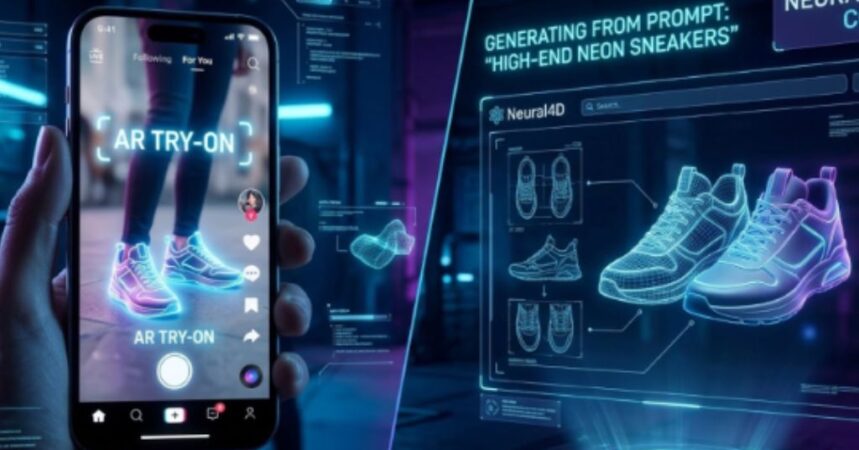
The social media marketing industry uses “speed to market” as its sole metric, which distinguishes between successful viral content and digital noise.
The traditional AI generated 3D models pipeline still creates major obstacles for brand engagement.
It is because AR (Augmented Reality) filters have become the preferred method of engagement on TikTok and Instagram.
Therefore, brands need to adopt fast AI 3D asset creation for their competitive requirements in 2026 because this technology enables them to create instant visual content that matches current viral trends.
Neural4D (N4D) is shifting this paradigm. By leveraging the Direct3D-S2 engine, N4D transforms the 3D creation process from a weeks-long technical hurdle into a seamless, automated workflow.
For a social media manager, a trend that is relevant today might be forgotten by Friday.
However, traditional 3D modeling, involving manual sculpting, retopology, and UV mapping, simply cannot keep up.
N4D’s Spatial Sparse Attention (SSA) mechanism changes the math of content production.
Firstly, N4D delivers high-fidelity models in seconds, not days.
This allows marketing teams to prototype and deploy AR assets while a trend is still peaking.
Secondly, speed doesn’t have to mean a sacrifice in quality.
The Direct3D-S2 architecture ensures that assets maintain a premium brand look, avoiding the “uncanny valley” or low-poly aesthetics often found in early AI tools.
Thirdly, the engine produces clean topology and watertight meshes, meaning the files are ready for immediate upload to Spark AR or Lens Studio.
Therefore, the secret to scaling campaigns lies in ensuring AI 3D assets are production-ready from the moment of generation, eliminating the need for tedious manual cleanup.
One of the most disruptive features for marketing teams is Neural4D-2.5, a conversational multi-modal model. Imagine a creative brainstorm where the team can “talk” a 3D asset into existence.
However, instead of sending complex briefs back and forth to a modeling agency, a social media lead can use Natural Language Instructions to refine an AR prop.
“Make the virtual sneakers more aerodynamic and change the texture to a matte obsidian finish.”
Meanwhile, the AI interprets these creative cues instantly, ensuring that the PBR Materials (Physical Based Rendering) react perfectly to the dynamic lighting environments of a user’s smartphone camera.
Therefore, this iterative loop ensures deterministic output what you see in the studio is exactly what the user experiences in the filter.
From a budgetary perspective, the shift to AI-driven 3D production is a game-changer for ROI.
| Feature | Traditional 3D Pipeline | Neural4D AI Workflow |
| Turnaround Time | 5–10 Business Days | < 60 Seconds |
| Technical Skill | Advanced (Blender/Maya) | Conversational/Intuitive |
| Compatibility | Manual Export Fixing | Native .glb / .fbx |
| Cost per Asset | High (Agency Fees) | Fractional (Scalable API) |
Therefore, by integrating the Neural4D API, brands can move away from one-off high-cost projects and toward a continuous stream of immersive content.
The introduction of generative AI to markets increases their worth while creating economic value for companies through reduced expenses, greater operational effectiveness, and enhanced ability to create 3D models.
Firstly, through AI generated 3D models, companies can fast-track their product development process, which normally takes several weeks into a matter of days.
Secondly, AI-generated optimized structures help the manufacturing, construction, and architectural industries to reduce material waste, which results in major cost reductions for their production processes.
Thirdly, AI automation handles time-consuming manual modeling tasks, which frees up staff members to concentrate on important business activities.
Fourthly, Generative AI enables businesses to create multiple 3D design variations, which require only a small increase in costs.
This capability makes it suitable for automotive fashion and e-commerce industries to produce customized products for their customers.
Fifthly, an AI-powered 3D content generation system brings efficiency to workflows, which decreases the time needed for manual work in game development and animation, and industrial design processes.
Finally, the traditional requirements for 3D modeling and rendering software require users to acquire expensive hardware and pay for subscription services.
However, AI-powered solutions eliminate the need for manual tools. Which decreases expenses while delivering better results.
Therefore, 3D models generative AI will establish itself as an essential element of digital design systems across the globe. It enhances artistic expression, operational efficiency, and production speed.
The development of AI models for 3D model creation needs the acquisition of top-notch training datasets. The datasets originate from three sources:
Therefore, the GSDC Certification programs teach professionals how to develop and improve generative AI technologies.
The AI model requires post-training fine-tuning to achieve peak output quality. The process of fine-tuning requires two essential steps:
In conclusion, as we move deeper into 2026, the brands that dominate social media will be those that treat 3D assets with the same agility as a 280-character tweet.
The Direct3D-S2 engine isn’t just a tool; it’s a competitive advantage that allows your brand to live inside the user’s camera feed. Therefore, stop waiting for the “render” and start leading the conversation. The revolution in AI 3D asset creation is here, and it is time for your brand to step into the third dimension.
Read Also:

Nabamita Sinha loves to write about lifestyle and pop-culture. In her free time, she loves to watch movies and TV series and experiment with food. Her favorite niche topics are fashion, lifestyle, travel, and gossip content. Her style of writing is creative and quirky.

sibashree bhattacharya, 4 days ago

Subham Kamila, 4 days ago