Newsletters For Law Firms: Top Tactics To Captivate New Clients
Barsha Bhattacharya, 5 hours ago

I have spent the last decade inside social feeds for a living.
I have been planning content calendars, chasing trends before they peak, and explaining to clients why “everyone is doing it” is a legitimate content strategy.
So, when my own feed turned into a wall of 1980s yearbook photos this September, I did what I always do.
I opened my scheduling tool and got ready to ride the wave.
Then I actually looked into what makes that wave possible, and I have not scrolled the same way since.
Yes, I am talking about the environmental impact of AI.

If you have opened Instagram, X, Threads, or Facebook in the past few weeks, you have almost certainly seen it.
Friends, influencers, and brands are turning their ordinary selfies into big-haired, film-grain, mall-photo-studio portraits stamped with a fake 1985 date.
The trend has spread across every major platform this September.
It is largely powered by ChatGPT’s image generation tools.
Also, it is exactly the kind of low-effort, high-nostalgia format that performs well in my client reports.
It is easy to explain, fun to try, and instantly recognizable in a feed.
What most people posting these photos don’t see is what happens between typing the prompt and the image appearing on their screen.
Each portrait is rendered inside a data center by processors that draw electricity and generate heat.
The heat then has to be managed with cooling systems that often use water.
A 2025 study examining 17 AI image-generation models found that energy use varied enormously between models.
Some consumed up to 46 times more than others, and simply increasing image resolution could push consumption higher.
None of that shows up in the caption.
However, I am someone who has to think about the full lifecycle of a piece of content.
It is not just how it performs, but what it represents.
So, it is worth understanding the impacts before the next trend replaces this one.
I will be upfront.
One image is not going to tip the planet into crisis.
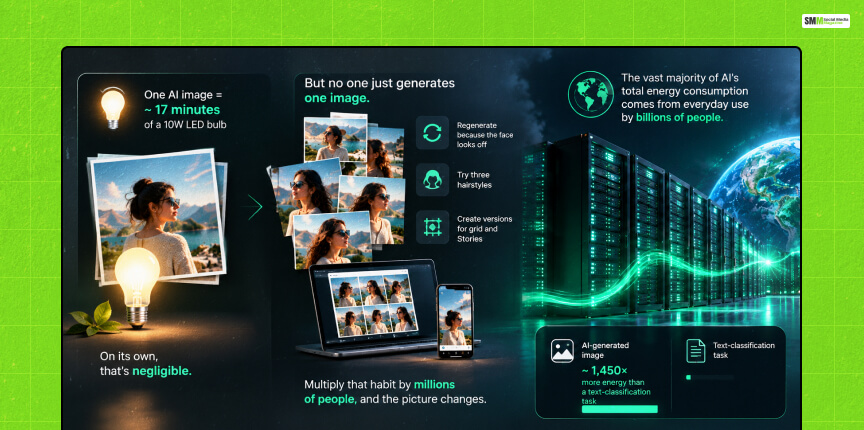
According to the United Nations University, generating a typical AI image uses roughly the electricity needed to run a 10-watt LED bulb for about 17 minutes.
On its own, that is negligible.
The problem, as anyone on social media knows, is that nobody generates just one image.
We regenerate because the face looks slightly off.
We try three hairstyles.
Also, we create a version for the grid and a different crop for Stories.
Multiply that habit by the millions of people currently running this trend, and the picture changes.
The same UN analysis notes that the vast majority of AI’s total energy consumption is done by the actual day-to-day use of AI tools by billions of people.
It is more than the one-time cost of training a model.
Image generation is a particularly heavy category within that.
A typical AI-generated image can require around 1,450 times the energy of a basic text-classification task.
It is a distinction I did not fully appreciate until I looked at the research.
Asking a chatbot a question and asking it to render a photorealistic image are not remotely equivalent tasks from a computing standpoint.
Image and video generation sit at the resource-intensive end of what generative AI does.
This matters for anyone (like most of us in content roles) who now uses AI for visuals daily, not just occasionally.

Electricity gets most of the headlines, but water is the part of this story that surprised me most.
So, AI’s footprint ecoprint was never purely a power-grid issue.
Data centers generate substantial heat, and cooling that heat can require water.
This water is used either directly, through evaporative cooling, or indirectly, through the water used to generate the electricity the facility consumes in the first place.
A 2026 study published in Water Research estimated that AI’s global water footprint could reach between 4.2 and 6.6 billion cubic meters annually by 2027.
The consumption includes cooling, electricity generation, and semiconductor manufacturing.
For each image, the number is small.
The UN University estimates the electricity-associated water footprint of one AI-generated photo at roughly two tablespoons.
However, the same scaling problem applies.
Two tablespoons times a trend involving hundreds of millions of people is a very different number.

No conversation about AI’s environmental footprint is complete without talking about Amazon.
Its AWS data centers sit at the center of several of 2026’s biggest fights over AI infrastructure.
As someone who writes about brand reputation for a living, this is the part of the story I find most relevant to my own work.
It is a live case study in the gap between a company’s sustainability messaging and its community relations.
For the first time, Amazon disclosed its global data center water use this year.
It has reported water consumption of 2.5 billion gallons in 2025.
It is roughly 5% of Seattle’s annual water usage.
The company says it “returned” about two-thirds of that water to local communities through infrastructure investment.
It is also a part of its public commitment to be “water positive” by 2030.
Amazon further reported that its data centers used 0.03 gallons of water per kilowatt-hour of electricity in 2025.
It was a 52% improvement in water efficiency since 2021, achieved largely by relying on air cooling and reserving evaporative cooling for the hottest days of the year.
That is a genuinely strong efficiency story on paper. However, it exists alongside a very different story on the ground.
In Indiana, Amazon wants to expand its data center campus.
So, it has requested state approval to permanently fill several acres of wetlands and reroute thousands of feet of streams near New Carlisle.
This plan has drawn sustained criticism at public hearings over flooding risk and water availability for local farms.
Amazon also has active expansions facing scrutiny in Fort Wayne, Michigan City, and Hobart, Indiana.
The tension is not limited to Amazon, and it is not always peaceful.
Indianapolis city councilman Ron Gibson had his home targeted with gunfire in April 2026.
It happened after he supported a data center rezoning vote, with a note reading “No Data Centers” left at the scene.
It is an incident cited by outlets covering the broader national backlash as a sign of how heated local opposition has become.
According to tracking firm Data Center Watch, at least 75 data center projects worth a combined $130 billion were disrupted by local opposition in the first quarter of 2026 alone.
Also, more than 300 data-center-related bills were filed across over 30 U.S. states this year.
Virginia, home to roughly 13% of the world’s data centers, has become the epicenter of this disruption.
Forty-two documented activist groups are now coordinating opposition across the state.
They are forming coalitions that bring together environmental groups and homeowner associations that wouldn’t normally be political allies.
| Metric | Figure | Source / Year |
|---|---|---|
| Global data center water use (2025) | 2.5 billion gallons | Amazon disclosure, 2026 |
| Water returned to communities | 66% (“water positive” goal by 2030) | Amazon, 2026 |
| Water efficiency improvement since 2021 | 52% | Latitude Media, 2026 |
| Water use per kWh (2025) | 0.03 gallons | Amazon, 2026 |
| Investment in NW Louisiana data centers | $12 billion | Louisiana Illuminator, Feb 2026 |
| Projects disrupted by local opposition (Q1 2026, all companies) | 75 projects/$130B | Data Center Watch, 2026 |
| Activist groups organizing in Virginia | 42 groups | ComputeForecast, 2026 |

I don’t have a science background.
So, I went looking for people who do.
The consensus among researchers is less “AI is destroying the planet” and more “we are building faster than we are measuring.“
Noman Bashir is a computing and climate impact fellow at the MIT Climate and Sustainability Consortium.
He has been blunt about the pace of the buildout.
“The demand for new data centers cannot be met in a sustainable way.
The pace at which companies are building new data centers means the bulk of the electricity to power them must come from fossil fuel-based power plants.”
MIT researchers project that data center electricity consumption could approach 1,050 terawatt-hours by 2026.
It is enough to rank data centers as the world’s fifth-largest electricity consumer, between Japan and Russia.
Elsa Olivetti, who leads MIT’s Climate Project decarbonization work, points to a different kind of gap.
It is not in the technology, but in our ability to evaluate it.
“We need a more contextual way of systematically and comprehensively understanding the implications of new developments in this space.
Due to the speed at which there have been improvements, we haven’t had a chance to catch up with our abilities to measure and understand the tradeoffs.“
That framing changed how I think about this.
So, AI is not uniquely catastrophic for the environment.
The tools we normally use to measure and regulate a new industrial process have not caught up to how quickly this one is scaling.
One detail from the research surprised me.
Some researchers distinguish between AI’s direct emissions (from data centers) and its enabled emissions.
A 2026 analysis published in npj Climate Action estimated these enabled emissions could be 3.3 to 13.3 times larger than AI’s direct data center emissions.
It is a reminder that the data-center-water-use headline, while real, is not the whole story.

This is the part I can speak to more directly, because it is the world I work in every day.
The broader social platform trend heading into 2026 is what the industry is now calling “algorithmic burnout.”
It is a growing fatigue with AI-generated content flooding feeds.
It is also sometimes labeled “AI slop” by users and even by journalists covering the space.
Meta’s own independent Oversight Board has flagged content authenticity and platform trust as core concerns for the year, alongside age restrictions and AI regulation.
Industry researchers tracking 2026 trends have also noted that platforms are struggling to sell AI features to everyday users.
This is because user fatigue and stricter regulation have squeezed engagement.
In other words, the appetite for “yet another AI filter” may already be closer to its ceiling than platforms would like to admit.
That tension of users wanting more human content while trends like the 80s photo filter go massively viral
It is not really a contradiction.
It is the same dynamic I see in every client account.
Novelty performs regardless of whether people say they are tired of it.
The environmental conversation is just now attaching itself to that same novelty cycle.
It is a new territory for those of us who plan content calendars for a living.
For brands and creators jumping on trends like this one, individual responsibility is a minor part of the equation.
The focus should be more on platform and vendor choices.
The practical levers experts point to are the same ones any of us can act on.
Moreover, we should ask the AI vendors we build workflows around to disclose their energy and water use.
Amazon, Google, and Microsoft have started to do so already.
| What | Figure | Source |
|---|---|---|
| Energy per typical AI image | 10-watt LED bulb running for 17 minutes | UN University |
| Energy vs. basic text classification | 1,450x more energy | UN University |
| Variation across 17 image models | Up to 46x difference | 2025 arXiv study |
| Water per AI image (electricity-associated) | 2 tablespoons | UN University |
| Global AI water footprint by 2027 (est.) | 4.2–6.6 billion cubic meters/year | Water Research, 2026 |
| Global data center electricity use by 2026 (est.) | 1,050 terawatt-hours | MIT Climate Portal |
| Global AI data center electricity by 2030 (est.) | Up to 945 terawatt-hours | UN estimate |
| Data center projects disrupted by opposition (Q1 2026) | 75 projects, $130B | Data Center Watch |
I am not going to pretend I am quitting AI tools.
Also, I don’t think most of my peers will either.
They are genuinely useful for ideation, drafts, and yes, viral-trend participation.
But this research has changed a few things about how I approach my own workflow and how I would advise clients.
It is not a fringe concern, but a live news topic.
That transparency gap is becoming a differentiator, not just a compliance checkbox.
You do not necessarily need to skip the trend.
There is a real difference between generating one fun photo and producing an endless stream of disposable AI content.
Also, the experts I have cited here are consistent on that point.
Individual guilt over a single image is misplaced.
The structural responsibility sits with the companies building and running this infrastructure.
They should have more efficient models and use renewable electricity and better cooling.
Also, they should offer the kind of transparent reporting Amazon, Google, and Microsoft have only recently started providing.
So yes, go ahead and post your 80s portrait. Just know that the “Vintage” filter you are using is very much a product of 2026’s power grid.
Trends have always had costs I could not see from the content calendar.
Ad spend, platform fees, creator burnout!
This is the first one where the invisible cost is literally a building full of servers drawing water and electricity somewhere I will never visit.
I don’t think that should stop any of us from doing our jobs.
But it has changed what I think “doing my job well” actually means.
Understanding not just what performs, but what it costs to make it perform, and being honest with clients and readers about both.

Sibashree has been into SEO and eCommerce content writing for more than 9 years. She loves reading books and is a huge fan of those over-the-top period dramas. Her favorite niches are fashion, lifestyle, beauty, traveling, relationships, women's interests, and movies. The strength of her writing lies in thorough research backing and an understanding of readers’ pain points.